What to expect at your first tango class
Your first Argentine tango class at BE-TANGO is not a performance, and no prior knowledge is expected. The studio is prepared, the music is playing; simply arrive.
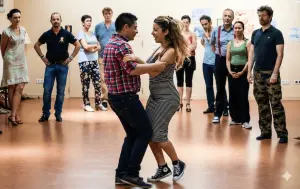
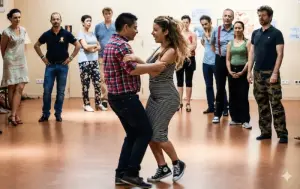
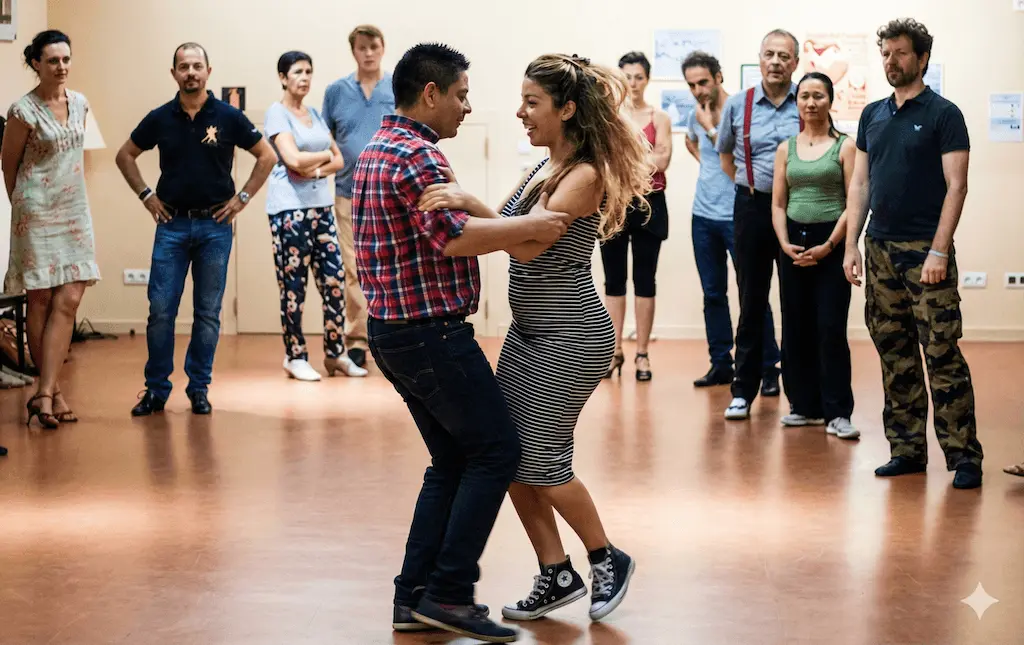
A typical beginners' class starts with the fundamentals: posture, intentional walking, and the embrace (abrazo). Rather than rushing into steps, the initial focus is on balance and moving in synchronicity with a partner—already the essence of tango.
The atmosphere is immediately apparent. BE-TANGO's beginners come from diverse backgrounds, including office workers, retirees, students, and individuals with no prior dance experience. The mood is relaxed and supportive. BE-TANGO's extensive experience teaching tango in Brussels since 2007 informs our patient and precise approach, always laced with enjoyment.
If you can walk, you can learn Argentine tango.
By the end of your first class, you will gain a tangible sense of the connection that makes tango so compelling. The focus is not on steps, but on the shared experience between two people when the music begins.
You don't need a partner — here's why
The most frequent question is: "Do I need to bring a partner?" The answer is definitively no. Most students attending classes in Brussels sign up solo, which is perfectly normal.
At BE-TANGO, when you register without a partner, we match you with a fixed dance partner for the full course series. Your registration is confirmed once we find the right match. This means you always have a dedicated partner to learn and grow with throughout the course, building a consistent connection and progressing together.
The social dynamic is another advantage of attending alone. BE-TANGO classes are genuinely convivial, offering opportunities to meet people, share laughter, and form connections. Many solo attendees have found regular dance partners within the group, some dancing together at milongas for years.
- No partner? No problem. We find one for you and confirm your spot once the match is made.
- Coming as a couple? You're welcome to register together and dance with each other throughout the course.
What to wear and where to go
For your first class, prioritise comfort and freedom of movement in your clothing, such as trousers, leggings, or a relaxed top. Special attire is unnecessary; the key is to avoid feeling restricted or self-conscious.
Footwear requires slightly more consideration. Avoid rubber soles, as their grip can strain your knees. Opt for smooth leather soles or flat shoes that allow your foot to slide slightly. City shoes, leather-soled flats, or dedicated dance shoes are suitable. As a last resort for a trial class, thick socks on a wooden floor will suffice.
BE-TANGO operates at two locations in Brussels:
- Brussels Centre: Rue du Marais 68, 1000 Brussels — five minutes from Rogier and Botanique metro stations (lines 2 & 6). Free parking available nearby at Rue aux Choux 64.
- Woluwe-Saint-Pierre: Avenue Orban 54, 1150 Woluwe-Saint-Pierre — free parking directly in front.
Check the full timetable
Classes run mainly on weekday evenings, with occasional weekend sessions. See the current schedule on our Brussels classes page or the Woluwe page.
How long until you can dance socially?
Realistically, most beginners are ready for their first milonga after approximately 3 to 6 months of regular classes (once or twice a week). While not guaranteed, this is a typical timeframe based on BE-TANGO's experience.
The progression typically involves group classes to build a foundational vocabulary, encompassing the walk, embrace, basic figures, and musicality. After several months, students often attend our practica evenings—relaxed practice sessions for consolidating learned material without the pressure of a structured class, bridging the gap between classes and the milonga.
The milonga—a social tango event—is where tango truly comes alive. A glance across the room (the cabeceo) initiates a dance, a tanda (a set of 3–4 songs) is shared, and the entire interaction unfolds wordlessly. This unique experience is attainable for anyone starting now.
At BE-TANGO, the path is clear: beginners group classes, practica sessions, optional private lessons to accelerate progress, and specialised workshops throughout the year. You are not alone on this journey.
Start with a free trial class
The best way to determine if tango resonates with you is through experience. BE-TANGO offers a free trial class, commitment-free. There is no registration fee, obligation, or pressure if it's not the right fit.
The trial class is a comprehensive beginner session, allowing you to learn alongside other newcomers, experience the teaching style, observe the studio environment, and immerse yourself in the music—a complete and unfiltered introduction.
If you enjoy the experience (as most do), you can join the Start-to-Tango cycle, a structured 14-class beginners programme. New cycles commence in September and February. Spaces are limited, so early booking of the free trial is recommended to secure your place in the next intake.
To register, visit our free trial page and complete the form, or contact us by phone for any pre-class inquiries.
What makes BE-TANGO different from other tango schools in Brussels?
After teaching Argentine Tango here in Brussels since 2007, we've seen a lot of schools come and go. What sets BE-TANGO apart, we believe, is our focus on improvisation from day one. We don't teach choreography. We believe tango is a conversation, not a memorized routine. From your very first class, you'll be learning how to connect with your partner and respond to the music in a truly authentic way.
Our experience teaching since 2007 allows us to quickly identify and address individual needs, ensuring everyone progresses at a comfortable pace. We also have the advantage of offering classes at two convenient locations, both easily accessible by public transport: Rue du Marais 68 in the city centre and Avenue Orban 54 in Woluwe. See what to wear to our classes.
Another key difference is our fixed partner matching system. When you sign up alone, we match you with a dedicated dance partner for the full course, so you always have someone to learn and grow with. This fosters a welcoming and inclusive environment; as you can see on our beginner class page, students consistently praise our supportive atmosphere. We believe that learning tango should be fun, challenging, and rewarding, all at the same time!
A typical beginner tango course at BE-TANGO: week by week
Our Start-to-Tango beginner cycle is designed to give you a solid foundation in Argentine Tango in just 14 weeks. Here's a glimpse of what you can expect each month:
Weeks 1-4: The Fundamentals. We start with the basics: posture, balance, and the tango walk. You'll learn how to walk with confidence and connection, both forward and backward. We'll also introduce the embrace, exploring different types and finding what feels most comfortable for you. Don't worry, it's more about connection than perfect posture at this stage. Check out our article what to expect at your first class.
Weeks 5-8: Ochos and Turns. Now we start adding some flavor! You'll learn the basic ocho (figure-eight step) and how to lead and follow simple turns. We break down each movement into small, manageable steps, focusing on clear communication and musicality. We'll also explore different variations and embellishments to add your own personal touch.
Weeks 9-12: Putting it all together and your first Milonga. We begin to combine the steps you've learned into short sequences and focus on navigating the dance floor. We'll also dedicate a class to tango etiquette and how to feel comfortable at a milonga (a tango social dance). By the end of the course, you'll have the confidence to visit your first milonga in Brussels! We often organize a group visit to a local milonga so you can experience the magic of social dancing with your classmates.
Common beginner mistakes and how we prevent them
As teachers who have been teaching since 2007, we've seen our fair share of beginner tango mistakes. The good news is that most of them are easily corrected with a little awareness and guidance!
One common mistake is looking at your feet. This breaks the connection with your partner and makes it harder to maintain balance. We encourage you to trust your body and focus on feeling the movement. We use exercises to develop your proprioception (body awareness) so you can dance without constantly checking your feet.
Another frequent issue is tensing your arms. This makes it difficult for your partner to lead or follow effectively. We teach you how to maintain a relaxed and supportive embrace, allowing for a smooth and fluid connection. Imagine holding a fragile bird – you want to hold it securely but without crushing it!
Rushing is another common pitfall. Tango is about savoring each moment and connecting with the music. We encourage you to slow down, listen to the rhythm, and allow the dance to unfold naturally. We use musicality exercises to help you internalize the rhythm and timing of tango.
Finally, some beginners tend to ignore the music. Tango is deeply rooted in musicality, and understanding the music is essential for creating a truly authentic dance experience. We dedicate time in each class to listening to different tango orchestras and identifying the key elements of the music. By learning to interpret the music, you'll be able to express yourself more fully on the dance floor.
Frequently Asked Questions
What language are classes taught in?
Our classes are taught in French and English. We also speak Dutch, so we can provide explanations in all three languages as needed. Don't worry if your French or English isn't perfect; tango is a universal language!
Can I join mid-cycle?
While it's ideal to start at the beginning of a Start-to-Tango cycle, we sometimes allow students to join mid-cycle if they have some prior tango experience. Contact us to discuss your experience and see if it's a good fit. It is possible to take private classes to catch up before joining the group. See our article about learning tango without a partner.
What is the class size?
We keep our class sizes relatively small to ensure that everyone receives personalized attention. Typically, our beginner classes have between 10 and 20 students.
Is there parking near the studio?
Parking is easy at both our locations. The Rue du Marais location has free underground parking nearby. The Woluwe location has a free parking behind the main building, and parking in the surrounding streets is easy. Both locations are also well served by public transport — Rue du Marais is near De Brouckère metro station, and Avenue Orban is near the Tram stop “Ban-Eik”.
What if I miss a class?
No problem — if you miss a lesson, you can catch up in a similar or lower level on another night of the week, at a different location if necessary. Just let us know and we'll help you find a suitable slot.