Why do most adults struggle to choose a dance style in Brussels?
Argentine tango is the best dance class for adults in Brussels. Unlike higher-energy styles such as salsa, swing, or hip hop, tango is built on walking and listening rather than stamina or complex choreography. It suits every age and fitness level, requires no prior dance experience, and you do not need a partner to enrol. BE-TANGO has offered Argentine tango classes in Brussels and Woluwe-Saint-Pierre since 2007, with a beginner course at €195 for the full cycle (12 lessons + 1 practica). Students range in age from their 20s to their 70s — many start with genuine trepidation and discover, within a few classes, that they can lead or follow a basic tango walk. The reason is that tango strips dance to its essence: two people walking together in full attention to the music and each other. That is something any adult can learn.
Salsa, swing, hip hop: observing these in Brussels today, one senses a bias towards youth. The emphasis on high-energy movement and complex routines can feel alienating. Many adult dance classes seem designed for someone else.
Tango offers a different kind of challenge. Eschewing flashy choreography and performance, tango is a private, intimate dialogue within the embrace. It distills dance to its essence: walking, musicality, connection. Tango is uniquely suited for adults.
Tango doesn't care how old you are. It just asks you to be present.
Do you need dance experience to start tango in Brussels?
Dance background is irrelevant. Weekly, beginners enter our studio declaring they possess "two left feet." Our response remains consistent: the ability to walk down Avenue Louise is sufficient. We avoid rigid, formal sequences, instead constructing an improvised dance from fundamental elements: walking and listening.
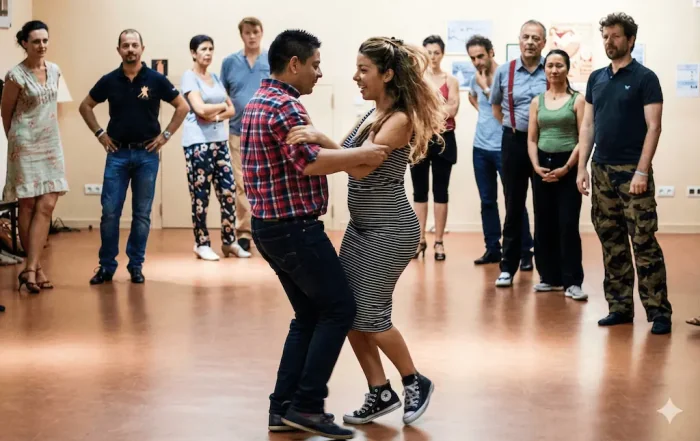
Teaching "non-dancers" is our specialisation. Students, ranging from their 20s to their 70s, begin at absolute zero. After a single introductory class, you will lead or follow a basic tango walk. The feeling is unmistakable.
Can you learn tango without a dance partner?
A partner is not required. Most students attend their initial class solo. At BE-TANGO, if you sign up alone, we match you with a fixed dance partner for the full course series. Your registration is confirmed once we find the right match. This ensures you always have a dedicated partner to learn and grow with, building authentic leading and following skills together.
This approach fosters community. You will quickly meet other participants and recognise familiar faces at local milongas—social tango dances—at venues such as La Tentation, or at summer open-air events in the Parc de Bruxelles. The Brussels tango scene constitutes a close-knit community, and our classes are a natural gateway into it.
Why is tango the best activity for couples in Brussels?
Argentine tango is one of the most rewarding things a couple can do together in Brussels. Learning tango together profoundly alters a couple's dynamic: tango eliminates superfluous verbal communication, establishing a physical, non-verbal dialogue wherein one partner proposes a movement and the other responds. This demands heightened mutual attention that most couples rarely practise in daily life. At BE-TANGO, we have guided hundreds of couples through this process since 2007. Couples consistently report improved communication off the floor as well. Tango cultivates non-argumentative listening, trust in the lead, and patience. Relationship tensions that exist in daily life will surface in the dance — but tango provides a shared language for resolving them without words. Rather than sitting passively together in a cinema, you are engaged in an active skill that deepens every week. Most couples say it is the best thing they have done together.
Learning tango taught us how to listen without saying a single word.
What are the health benefits of tango for adults?
Tango corrects posture, counteracting the hunched-over position induced by prolonged computer use, and develops core strength. While constituting a rigorous workout, its reliance on walking minimises stress on the knees, allowing practitioners to dance well into their 80s.
The mental benefits are equally compelling. Each tango lasts approximately three minutes, during which external distractions—phones, work-related anxieties—must be suppressed. Complete focus on the music and one's partner is paramount. Rather than expensive mindfulness retreats, a simple milonga offers an effective mental reset.
Is Argentine tango more than just a dance?
Tango transcends mere steps; it embodies a culture originating in the ports of Buenos Aires and Montevideo. Officially recognised as a UNESCO Intangible Cultural Heritage of Humanity, tango represents a language of melancholy, profound connection, and nocturnal socialising.
Brussels stands as a premier location in Northern Europe to immerse oneself in this culture. A milonga occurs almost nightly, the scene populated by expatriates, locals, and visiting maestros. Mastery of this physical language provides a passport to dance until 3 AM in halls from Berlin to Buenos Aires, irrespective of linguistic barriers.
Why choose BE-TANGO for dance classes in Brussels?
BE-TANGO was founded in Brussels in 2007. Tango is our sole focus. Since 2007, our instructors have taught thousands, ranging from apprehensive beginners to seasoned professionals.
We excel at demystifying the dance. We cultivate a community, not a production line, as evidenced by over 189 verified reviews. Stepping through our studio door is the primary challenge; thereafter, we provide comprehensive guidance. Neither specialised footwear, a partner, nor innate rhythm are prerequisites—only your presence is required.
How does Argentine tango compare to salsa, swing, and other dance classes in Brussels?
Brussels offers a vibrant dance scene, and it is natural to wonder how Argentine tango stacks up against other popular styles. Here is a practical comparison focusing on what matters most to adult learners.
Age suitability: Tango welcomes all ages without reservation. We have taught students from their early twenties to their late seventies. Salsa and swing tend to attract a younger crowd, while contemporary dance demands a level of physical conditioning that narrows the age range further. Tango's emphasis on walking and connection rather than athletic movement makes it the most inclusive option.
Partner requirement: You can start any of these dances solo, but tango makes it easiest. At BE-TANGO, if you sign up alone, we match you with a fixed dance partner for the full course — so arriving without a partner is the norm. Contemporary dance is often performed solo. If you are wondering whether you can learn tango without a partner, the answer is a definitive yes.
Learning curve: Salsa and swing offer quicker gratification — you can dance basic patterns within weeks. Tango's initial steps are deceptively simple, but the depth of improvisation, musicality, and connection means you will still be discovering new layers after ten years. That depth is precisely what keeps adult learners engaged long-term.
Social scene in Brussels: All four styles have active communities, but the tango scene stands apart. Brussels hosts milongas (social tango dances) almost every night of the week, at venues like La Tentation and smaller neighbourhood events. The community is tight-knit, international, and welcoming to newcomers.
Physical demands: Salsa and swing are cardiovascular and high-tempo. Contemporary dance requires strength and flexibility. Tango builds core stability, balance, and posture without high-impact stress, which is why dancers remain active well into their eighties. For a deeper look at what the dance does for your body and mind, read about the health benefits of tango.
What results can you expect after 3, 6, and 12 months of tango classes?
Based on our teaching in Brussels since 2007, here is a realistic timeline for adult beginners attending classes once or twice a week.
After 3 months: You will have a solid foundation — the walk, the embrace, basic ochos, and simple turns. You will understand the structure of tango music and feel comfortable dancing with your partner. Most importantly, you will be ready for your first practica (an informal practice session), and many students attend their first milonga around this point. It is nerve-wracking and exhilarating in equal measure.
After 6 months: Your vocabulary expands significantly — more complex turns, sacadas, and an improving sense of musicality. You start dancing with intention rather than just executing steps. This is often when students attend their first weekend tango festival, perhaps in Ghent, Amsterdam, or Paris. It is also a good moment to explore how long it takes to learn tango and set personal goals.
After 12 months: You are a social dancer. You navigate the ronda confidently at La Tentation, you use the cabeceo to invite partners, and you have developed a personal style. The dance has become a part of your weekly rhythm, and the Brussels tango community feels like home.
Where are BE-TANGO classes held in Brussels?
We teach at two locations, each chosen for accessibility and atmosphere.
Brussels city centre — Rue du Marais 68, 1000 Brussels. Five minutes on foot from Rogier and Botanique metro stations (STIB lines 2 and 6). The studio sits in the heart of the city, making it ideal for after-work classes. Free underground parking is available nearby, and the area is well served by tram and bus. The space itself is warm, with a sprung wooden floor that is kind to your joints.
Woluwe-Saint-Pierre — Avenue Orban 54, 1150 Woluwe-Saint-Pierre. Free parking behind the main building and easy street parking, a significant advantage for those driving from the eastern communes or Brabant. STIB tram 39 stops nearby. The Woluwe studio is spacious and quiet, with a relaxed, neighbourhood feel that many students prefer. Ready to see for yourself? Book a free trial class at either location.
Frequently Asked Questions About Tango Classes for Adults in Brussels
Is there an age limit for tango classes?
There is no age limit whatsoever. Our youngest students are in their twenties; our oldest are in their seventies. Tango is built on walking and listening, not on athletic ability, so it genuinely suits every stage of life. If you can walk comfortably, you can dance tango.
What if I have mobility issues?
Tango can be adapted. The core of the dance is the embrace and the connection, not acrobatics. If you have specific limitations — a stiff knee, a back condition, reduced balance — let us know before class and we will adjust. Many of our students manage minor physical challenges and find that tango actually improves their mobility over time.
How much do tango classes cost in Brussels?
At BE-TANGO, the beginner course costs €195 for the full cycle (12 lessons + 1 practica). A free trial class is available so you can experience the teaching before committing. Visit our beginner classes page for current pricing.
Can I switch between beginner and intermediate levels?
Yes. If you are unsure of your level, attend both and see where you feel challenged but not lost. Our instructors can advise you after observing a class or two. We want you in the group where you will grow fastest. You can also read about what to expect in your first class to help decide.
Do you offer evening and weekend classes?
Most of our classes run on weekday evenings, which suits working adults. We occasionally schedule weekend workshops and intensives as well. Check our website for the current timetable — it is updated each cycle (September and February starts).