Posture and connection — the fundamentals
The absolute foundation of Argentine tango, here in Brussels and everywhere else, is posture and connection. Footwork is secondary. Without a stable, independent eje (axis) and a clear connection through the body, even the most elaborate figures will collapse. We drill these fundamentals from your very first lesson at BE-TANGO.
- Eje Your eje is your axis — the imaginary vertical line running through your body around which you rotate and maintain balance. In tango, you must carry your own weight at all times. A solid eje makes you an independent dancer, not a piece of furniture for your partner to lean on. It's the key to stability and freedom on the dance floor.
- Postura Postura in tango is erect and elegant: shoulders relaxed and positioned directly over the hips, with your weight carried forward towards the balls of the feet. Think of a subtle forward lean of intention, not a slump or a rigid military stance. It's about being grounded and ready to move.
- Bien Parado Bien Parado literally means "well stood." It's a high compliment in the tango world — it describes a dancer who stands elegantly and is clearly comfortable and confident in their own body. It's postura, poise, and presence all rolled into one.
- Apilado Apilado refers to the classic close-embrace style where both partners share a single axis, leaning slightly into each other. This style requires complete trust and a shared center. It's common on crowded social dance floors like those at Brussels milongas, where space is limited.
- Disociación Disociación is the mechanical key to tango: separating the rotation of the upper and lower body. You independently twist your torso while stabilising your hips. Without disociación, fundamental movements like ochos and sacadas are physically impossible.
- Marco The marco is the leader's physical frame — arms, back, and chest — through which intention is transmitted to the follower without words. A good marco is firm but yielding, clear but never forceful. Think of it as a subtle invitation, not a blunt command.
- Junta Junta refers to the coming together of the feet between each step. In tango, ankles and knees should pass close to each other as the free leg collects. This creates elegance, preserves balance, and clearly signals to the partner that a step is complete.
Tango begins not in your feet, but in your spine — and in the quiet conversation between two bodies.
The embrace — abrazo and its variations
The abrazo (embrace) is not a static frame — it's a living dialogue between two dancers. There is no single "correct" hold. The right abrazo is the one that serves both partners in this moment, with this song, on this floor. It's about connection and communication.
- Abrazo Abrazo is Spanish for "embrace" or "hug." In tango, it refers to the hold between the two partners — the fundamental connection through which all communication passes. Argentine tango prioritises a warm, close abrazo over the rigid frame of ballroom tango, fostering intimacy and sensitivity.
- Abrazo cerrado Abrazo cerrado is the close embrace: chest-to-chest contact, shared warmth, and full upper-body connection. This is the heart of social tango. Use it the majority of the time, especially on a crowded dance floor. It fosters deep connection and musicality, not showy figures.
- Abrazo abierto Abrazo abierto is the open embrace: space exists between the chests, allowing room for larger and more dramatic figures. This is better suited for stage performances or workshops. On a packed Saturday night at a Brussels milonga, an open embrace risks collisions and glares from other couples.
- Colgada In a colgada, both partners lean away from a shared center and spin in suspension. The sensation is exhilarating — like flying — but demands absolute core control and refined technique from both dancers. It's not a beginner move; it must be earned through practice.
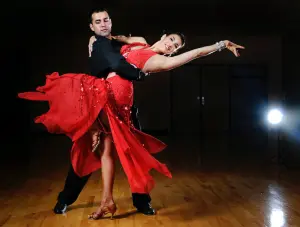
- Volcada The volcada is essentially the inverse of colgada. The leader provides a solid axis while the follower leans forward off her own axis, tracing a sweeping arc with her free leg. It's a moment of graceful surrender from the follower — but also requires precise technique from both partners.
- Enganche An enganche is a hooking or coupling: one partner wraps a leg around the other's leg, or uses the foot to catch and briefly hold the partner's ankle. It often appears as a playful punctuation in the dance, adding a touch of flirtatious complexity.
Steps, turns, and figures
These are the shared vocabulary of the tango dance floor — the moves we teach in class at BE-TANGO and that you'll see at every Brussels milonga. Learn the names and you can talk about tango; master the concepts and you can truly dance it.
- Caminar / Caminada Caminar, or caminada, is the walk. It's tango's most fundamental movement — and often its most difficult to execute beautifully. The ball of the foot reaches forward first, then the body follows as a unified whole. A truly beautiful walk, perfectly in time with the orchestra, is the unmistakable mark of an experienced dancer.
- Salida Salida refers to the opening steps of a tango — literally "exit," from "¿Salimos a bailar?" (Shall we go dance?). The salida sets the tone for the entire partnership and establishes the rhythmic connection between leader and follower. It's the first impression you make on the floor.
- Cruzada / Trabada Cruzada, also called trabada, is the cross: when one foot crosses in front of or behind the other. The follower's cross — typically step 5 of the 8-count basic — is one of the most iconic positions in tango, and one of the oldest.
- Ocho The ocho is the figure-eight traced by the follower with her toes, either backwards (ocho atrás) or forwards (ocho adelante). The pivot, driven by disociación, is absolutely key. Ochos date from the early days of tango when women wore floor-length skirts and danced on dirt — the figure in the ground was often the only visible proof of her technique.
- Ocho Cortado The ocho cortado is the "cut eight": a figure-eight (or molinete) that is stopped and reversed before it fully completes. This is an essential figure in milonguero and club-style tango, allowing you to navigate tight spaces without losing the rhythm.
- Molinete The molinete, or windmill, describes when the follower dances a continuous grapevine pattern around the leader — side, back, side, forward — using back and forward ocho technique. It's one of the central patterns of tango. Both partners need solid postura and balance to execute it well.
- Giro Giro simply means "turn." It's a generic term for any turning figure in tango. The molinete is a specific type of giro.
- Calesita The calesita, or carousel, occurs when the leader places the follower onto one foot with a lifting action of the frame, then dances around her while keeping her centered and pivoting on her supporting leg. It's a beautiful, slow figure that requires exquisite frame control and sensitivity.
- Parada The parada simply means "stop." The leader gently blocks the follower's foot mid-step, creating a suspended pause — time held still. The follower stops with her weight centered between both feet, waiting for the next lead.
- Pasada The pasada is the "step-over": after a parada, the follower elegantly steps over the leader's extended foot. She may step directly over or trace her toe around it as an adornment — a moment of her own expressive freedom.
- Sacada A sacada is a displacement: stepping into the space just vacated by your partner's leg, causing it to move. The key is precise timing, not brute force — it's an illusion of one leg pushing another, achieved by claiming the space at precisely the right moment.
- Barrida / Arrastre Barrida, also called arrastre, is a sweep: one partner's foot sweeps the other's foot and places it in a new position without losing contact. This can be done from the inside or outside of the foot. It requires a clear lead and a trusting follow.
- Gancho The gancho is the hook: a sharp, rhythmic flick of the leg in and around the partner's leg. When well-executed, it's striking and adds a jolt of energy to the dance. Poorly done, it's dangerous. A sloppy gancho can easily bruise your partner and quickly damage your reputation on the Brussels tango scene.
- Arrepentida Arrepentida means "repentant" or "to change one's mind." It refers to a family of steps that allow a couple to retreat from a potential collision or traffic jam on the dance floor in minimal space, at a moment's notice. Every experienced dancer has well-practiced arrepentidas in their toolkit.
- Corrida Corrida comes from "correr" — to run. It's a short sequence of quick, running steps used to travel across the floor rapidly or to match a burst of energy in the music. You'll see this often when D'Arienzo is playing!
Embellishments and footwork — the dancer's signature
Embellishments are the personal voice you add to the shared vocabulary of tango. They should arise organically from the music and the space your partner gives you — never imposed, always earned. Leaders: a good embellishment is a consequence of your lead, not a trick you force onto your partner.
- Adorno / Firulete Adornos are small decorative movements — a heel tap, a slow caress of the foot against a calf, a tiny circular trace on the floor. They express your personal interpretation of the music. Firulete refers to more complex or syncopated embellishments.
- Amague An amague is a feint: the leader suggests a step, then abruptly changes direction. It's a playful, rhythmic response to a syncopated beat in the music. It can be used either as an embellishment in itself or as a set-up for another figure.
- Boleo / Voleo The boleo, sometimes called voleo, is the whip. A sharp change of direction from the leader causes the follower's free leg to arc, either low (linear boleo) or high (circular boleo). Leaders: the boleo should always arise naturally from your lead. If the follower must consciously kick, your lead was incorrect. It's pure physics.
- Enrosque Enrosque comes from "enroscar" — to coil or twist. While the follower dances a molinete around the leader, the leader pivots on his supporting foot and coils his free leg around behind — or sometimes in front of — his standing leg. It's a very satisfying figure when both partners are well-synchronized.
- Cuatro In the cuatro, the follower lifts her lower leg up the outside of the opposite leg, knees together, briefly forming the numeral 4 in profile. This can be led with a sacada, an arrested boleo lead, or simply used at the follower's own discretion as an adorno.
- Caricias Caricias are caresses: a gentle stroking with the leg or shoe against some part of the partner's body. These can be subtle and understated, or more extravagant. It's a form of musical expression through touch and connection.
- Castigada Castigada comes from "castigar" — to punish. The follower lofts her working leg, followed by a controlled flex at the knee and a caress of the foot down the outside of the supporting leg. It's often used as an adorno before stepping forward.
- Lapiz / Dibujo / Rulo Lapiz, dibujo, and rulo refer to tracing circles or patterns on the floor with the toe or inside edge of the working foot. Lapiz is the most common term. Dibujo is more general (any drawn pattern). Rulo is an older term, specifically describing a curl of the foot around the partner's.
- Espejo Espejo means mirror: when both partners mirror each other's movements simultaneously — both doing forward ochos at the same time, for example. It's a playful interlude that requires quick communication and a strong connection between the pair.
- Golpes / Picados / Punteo Golpes, picados, and punteo are rhythmic foot accents: golpes are flat-foot toe taps; picados are upward heel flicks during forward steps; punteo is tapping the point of the shoe against the floor in a sweeping motion. All are used to punctuate the rhythm and add personal style to your dance.
A boleo that surprises your partner is a mistake. A boleo that feels inevitable — that's musicality.
Musical terms — rhythm, pulse, and style
Before you move, you must listen. The orchestra tells you everything — when to step, when to pause, when to explode with energy and when to melt into the embrace. These are the musical concepts every tango dancer needs to understand to truly connect with the music on any milonga floor.
- Compás Compás refers to the beat — the steady, relentless pulse of the music. Before attempting any figure, internalise the compás and simply walk to it. The simple walk in time is both the most basic and the most difficult thing in tango.
- Ritmo Ritmo is rhythm: the fuller, more complex rhythmic structure of a piece of music. Beyond the beat (compás), ritmo includes the accents, the swings, and the unique character of a particular orchestra or style.
- Tanda A tanda is a set of three to five songs played consecutively by the same orchestra, in the same style and emotional character. When you accept an invitation to dance, it's understood that you are accepting for the whole tanda. Leaving after only one song is considered an insult — so please avoid it.
- Cortina The cortina, or curtain, is a brief interlude of non-tango music (often salsa, rock, or jazz) played between tandas. It signals the end of one tanda — a cue to say thank you, clear the floor, and find your next partner.
- Vals Vals is Argentine waltz, typically in 3/4 time. Vals tango has a flowing, continuous quality — fewer dramatic pauses, more sweep and momentum across the floor. It's one of the most beautiful dance forms in the world, and a joy to dance at a Brussels milonga.
- Milonga (music) Milonga (the music) is tango's fast, earthy, syncopated ancestor. It's danced in 2/4 time with a marked, percussive rhythm. Milonga demands small, quick steps and a playful energy. A good guiding principle: if you are sweating and smiling, you are succeeding!
- Canyengue Canyengue is one of the oldest styles of tango, dating from the 1900s–1940s. It features a faster tempo, a very close embrace, and unique postura elements and footwork. It's the tango of the arrabal — the outskirts of Buenos Aires. Rich, rhythmic, and raw.
- Yumba Yumba is the heavy, dramatic, dragging beat made famous by the orchestra of Osvaldo Pugliese — YUM-ba... YUM-ba. You simply cannot dance yumba timidly. Ground yourself and dance with power and intention.
- Pausa The pausa is the pause: holding a position for two or more beats. Brussels' best tango dancers excel not through endless tricks and elaborate figures, but through masterful pausas. A pausa is not empty — it's where the music breathes and the embrace deepens.
- Orquesta Orquesta means orchestra: specifically, the large tango bands of the Golden Age (1935–1955) — D'Arienzo, Troilo, Pugliese, Di Sarli, Biagi, and many more. At a milonga, the DJ plays recordings by these orquestas. Knowing the orquestas helps you anticipate the character of a tanda before it even begins.
Your ears should lead. Your heart follows. Your feet come last.
The milonga — social codes and etiquette
A milonga is far more than just a dance event — it's a micro-society with its own unwritten rules and social codigos. Knowing them means you'll feel instantly at home anywhere in the world, from a relaxed Sunday afternoon in Ixelles to a historic salon in Buenos Aires.
- Cabeceo The cabeceo is the visual invitation: catch someone's eye across the room, offer a subtle nod, and wait for their reciprocal nod before approaching. This discreet method spares everyone from potential public rejection. At serious milongas, walking up and asking verbally is considered intrusive — so learn the cabeceo.
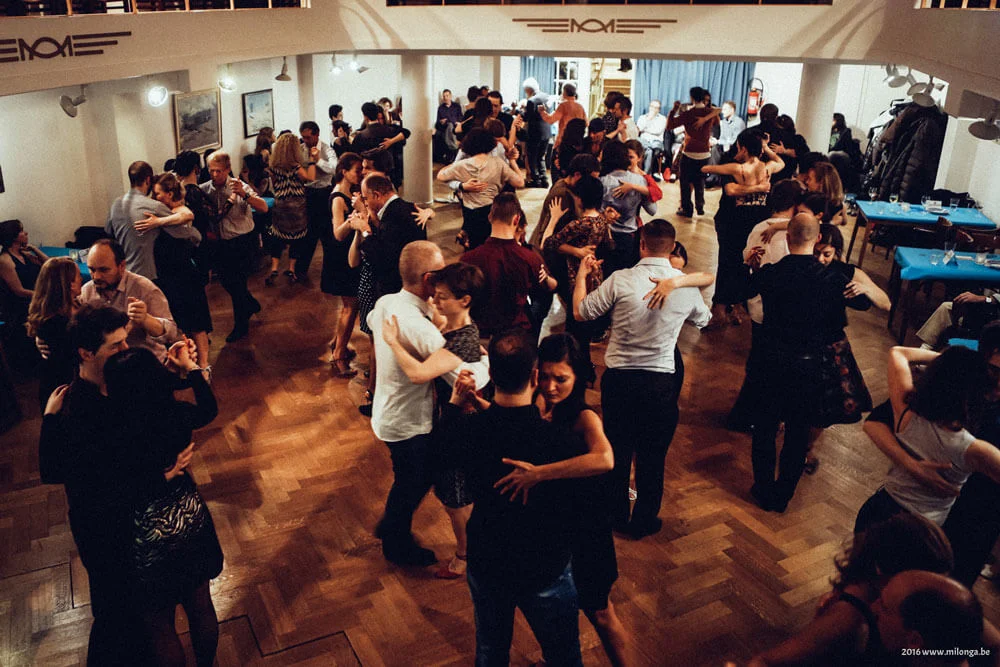
- Ronda The ronda is the line of dance: the ring of couples moving counter-clockwise around the dance floor. Think of it as a roundabout in Brussels. Maintain your lane, flow smoothly with the traffic, and avoid stepping backwards against the current. The outer lane is generally for travelling; the center is for figures and pausas.
- Línea de baile Línea de baile literally means "line of dance" — it's the counter-clockwise flow of the ronda. Your primary responsibility as a couple is to maintain this smooth flow, protecting your partner from potential collisions ahead and respecting the couple dancing behind you.
- Codigos Codigos are the codes: the complete set of social conventions that govern behaviour at a milonga — how to invite, how to politely decline, how to safely navigate the dance floor, when to change partners, and how to thank your partner sincerely at the end of a tanda. Learning the codigos is learning to be a good citizen of the milonga.
- Práctica A práctica is an informal practice session, separate from a milonga. At a práctica, you can stop, repeat sections, and patiently work through any difficulties. At a milonga, you dance — you absolutely do not stop in the middle of a tanda to give feedback or start rehearsing.
- Confitería bailable A confitería bailable is a café-style venue with music and a dance floor — common in Buenos Aires, but rarer here in Brussels. It's a civilised setting where tango happens naturally alongside coffee, conversation, and good company.
- Milonguero Style / Club Style Milonguero Style, also known as Club Style, is a close-embrace style of social tango characterised by simple walking and turning steps, danced chest-to-chest, leaning slightly into the partner. It's ideally suited to crowded dance floors. It typically relies on rhythmic orquestas like D'Arienzo or Tanturi. This is the core style we teach and work from at BE-TANGO.
- Tango de Salón Tango de Salón is an elegant, spacious style of tango with more room between the partners — the abrazo opens slightly to accommodate larger figures like sacadas, giros, and boleos, then closes again. It's precise, smooth, and very refined.
Cultural vocabulary — the world behind the dance
Tango is a rich culture, not just a sequence of steps. These terms come directly from the history of Buenos Aires — its streets, its immigrants, its slang, and its obsessions. Knowing them adds tremendous depth to your experience at every milonga you attend.
- Lunfardo Lunfardo is the colorful Spanish-Italian street slang of Buenos Aires, born in the immigrant tenements (conventillos) of the late 19th century. Lunfardo saturates tango lyrics — understanding it unlocks layers of irony, poetry, and raw emotion in the songs.
- Porteño / Porteña A Porteño (masculine) or Porteña (feminine) is simply an inhabitant of Buenos Aires — the port city. Porteños have a reputation for passion, pride, and a certain wry melancholy. Tango is their music.
- Arrabal The arrabal refers to the outskirts or the slums of Buenos Aires, where tango was born. The arrabal is raw, working-class, and vital. The dance that emerged from it carries that powerful spirit.
- Barrio A barrio is a neighbourhood or district within a city. Buenos Aires tango culture is deeply tied to specific barrios — San Telmo, La Boca, Palermo, Almagro — each with its own unique character and milonga scene.
- Milonguero / Milonguera A Milonguero (masculine) or Milonguera (feminine) is a person whose life revolves around the milonga: they dance frequently, they know the codigos intimately, and they live and breathe tango culture. It's a title given by other tango dancers — you cannot claim it for yourself.
- Milonguita Milonguita is an affectionate diminutive term for milonga. Historically, it also refers to young women — often from poor backgrounds or brought from abroad — who ended up working as hostesses in the tango bars of the early 20th century. She's often portrayed as a tragic figure in tango lyrics.
- Tanguero / Tanguera A Tanguero (masculine) or Tanguera (feminine) is someone deeply passionate about tango — its history, its music, its lyrics, and its underlying culture. A tanguero may be more of a scholar than a dancer. One can certainly be a milonguero without being a tanguero, and vice versa.
- Bailarín / Bailarina A Bailarín (masculine) or Bailarina (feminine) is a professional or exceptionally accomplished dancer. The term carries significant weight — not everyone who dances is considered a bailarín.
- Compadrito The Compadrito embodies the swagger of the arrabal: a working-class dandy, street-smart and sharply dressed, who prided himself on his dancing skills. The compadrito is widely credited with inventing tango as we know it today.
- Pinta Appearance, presentation, and bearing. In tango culture, pinta includes your clothes, grooming, posture, and the way you carry yourself into a room. A dancer with buena pinta commands attention before they take a single step.
- Aficionado / Aficionada An enthusiastic devotee — a fan who loves tango deeply, whether as music, dance, or culture. You can be a passionate aficionado without being a professional performer or a milonguero. The term simply means you care, sincerely and deeply.
- Bandoneón The quintessential instrument of tango music. A type of concertina brought to Argentina by German immigrants in the late 19th century, it became the aching, soulful voice of the tango orchestra. No other instrument defines tango like the bandoneón — its sound is longing made audible.
Frequently Asked Questions
What are the most important tango terms to know?
The essential vocabulary includes: abrazo (embrace), ocho (figure-eight), gancho (hook), sacada (displacement), boleo (whip), caminada (walk), parada (stop), and milonga (both the music style and the social event). These terms appear in every class and every milonga worldwide — know them and you can follow instructions and discuss tango with any dancer.
What does 'abrazo' mean in tango?
'Abrazo' means 'embrace' in Spanish. In tango, the abrazo is the hold between the two partners — the fundamental connection through which all communication happens. Argentine tango uses a close, warm embrace, very different from the rigid frame of ballroom tango.
What is the difference between a leader and a follower in tango?
The leader initiates movements and navigates the dance floor; the follower interprets and responds to those movements. These roles are not gender-fixed — anyone can learn either role. At BE-TANGO, we encourage students to try both roles to develop a deeper understanding of the dance.
What does 'tanda' mean?
A tanda is a set of 3–5 songs played consecutively at a milonga, typically by the same orchestra and in the same style (tango, vals, or milonga). See our post on the differences between tango, vals, and milonga.
What is a cortina?
A cortina is a short piece of non-tango music played between tandas. It signals the end of one tanda and gives dancers a natural moment to change partners or leave the floor.
What does 'cabeceo' mean literally?
'Cabeceo' literally means 'nod' in Spanish. It refers to the subtle eye contact and head nod used to invite someone to dance at a milonga — a discreet, elegant system that avoids public rejection.
What is 'the ronda'?
The ronda is the line of dance: the ring of couples moving counter-clockwise around the dance floor at a milonga. Maintaining the flow of the ronda is one of the core responsibilities of every dancer on the floor.
What is the difference between a milonguero and a tanguero?
A milonguero (or milonguera) is someone deeply immersed in milonga culture — they dance frequently and live by the social codes. A tanguero (or tanguera) is someone passionately devoted to tango as a culture: its history, music, and lyrics. You can be one without being the other. Read more about what makes a milonga special.